Our Iconic Sign Is Going Dark — and the Money to Fix It Is Gone
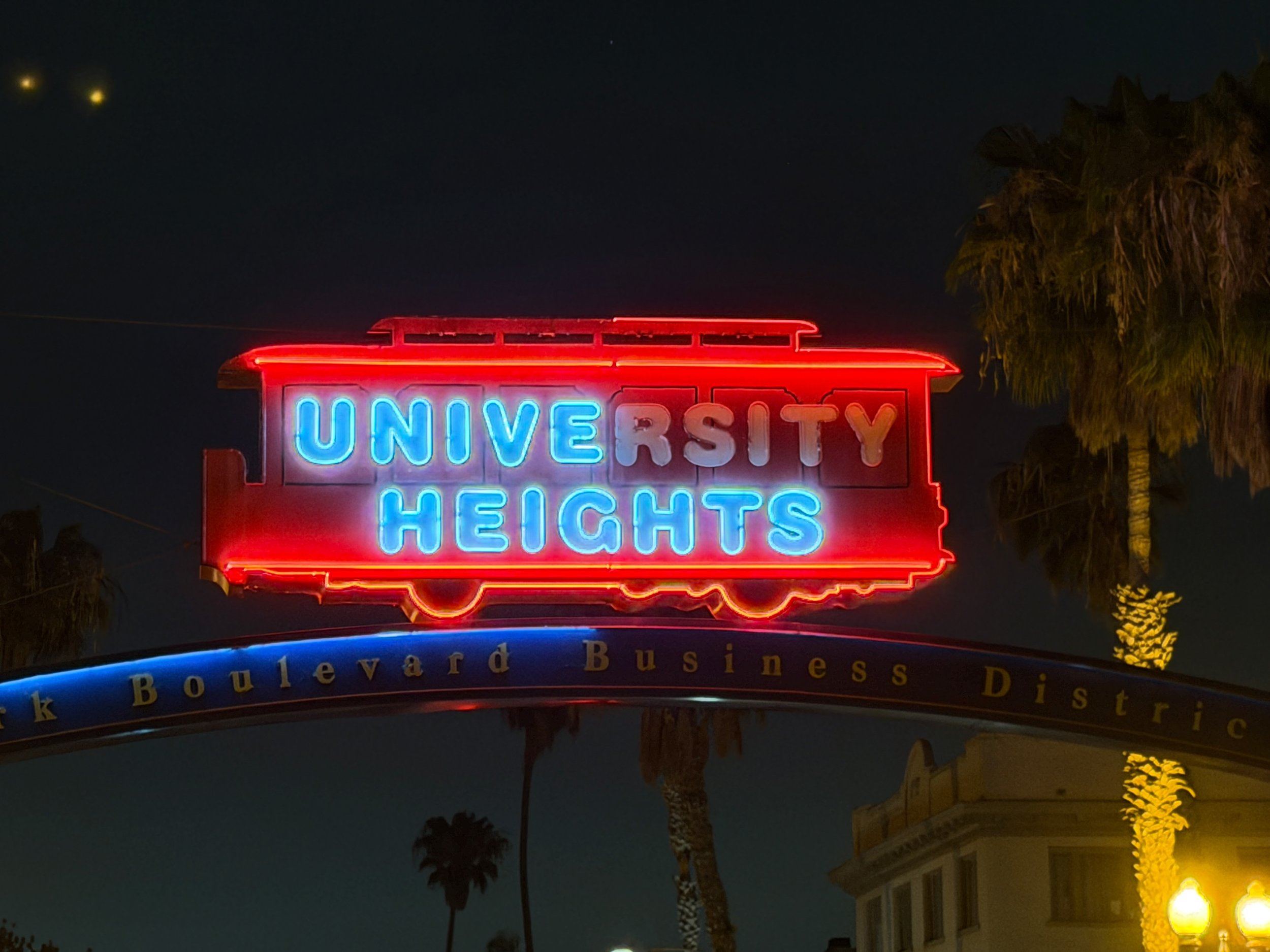
UH Trolley Sign facing north with white and red neon elements out, photo by Marc Johnson 6/12/26
By Marc Johnson, President, and Angela Jackson-Llamas, Vice President and the UHCA Board • Featured in the July/August UH News print edition.
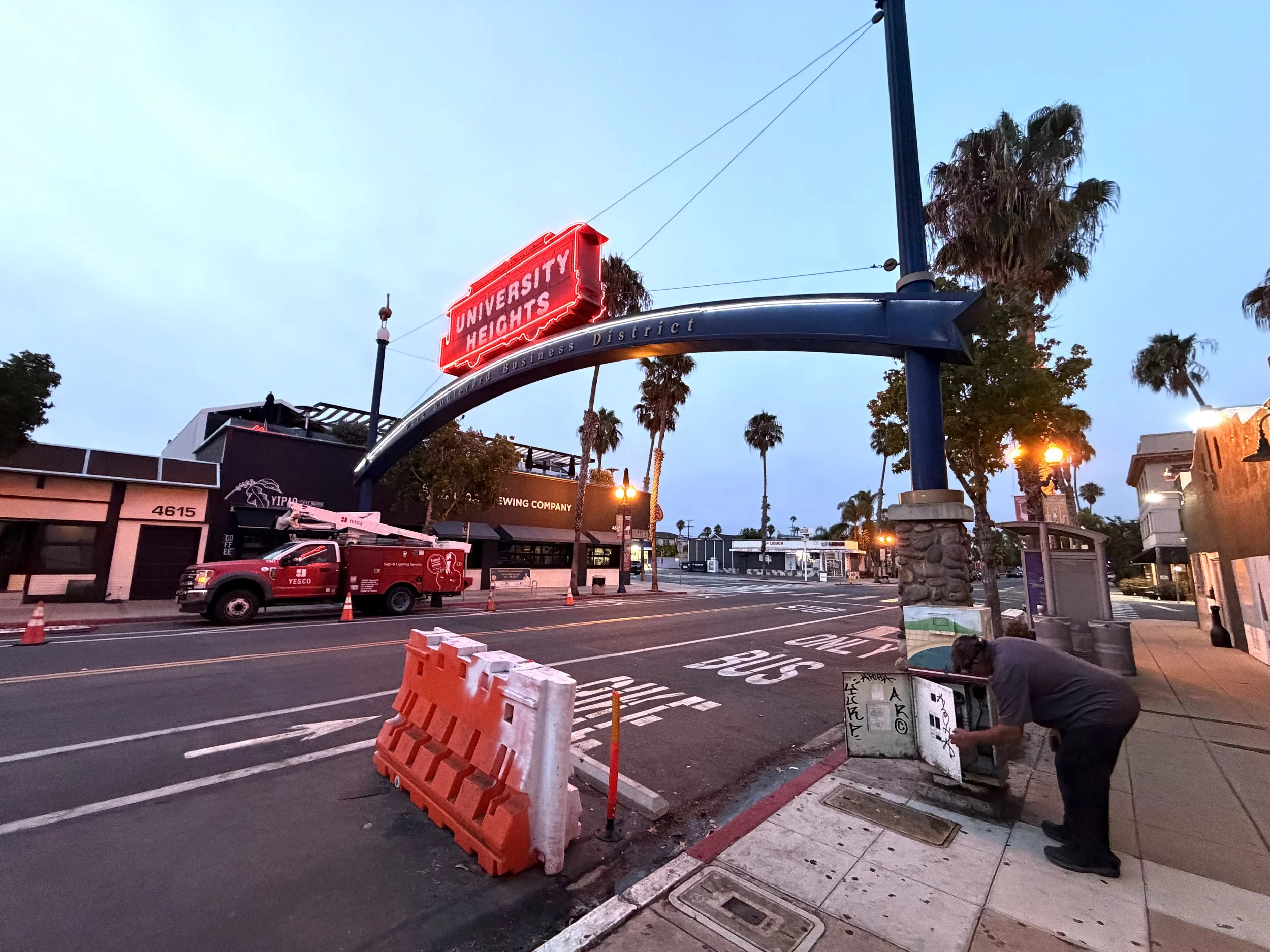
September Update: the neon is being replaced - now it’s up to us to raise money for the rest. See the full story here:
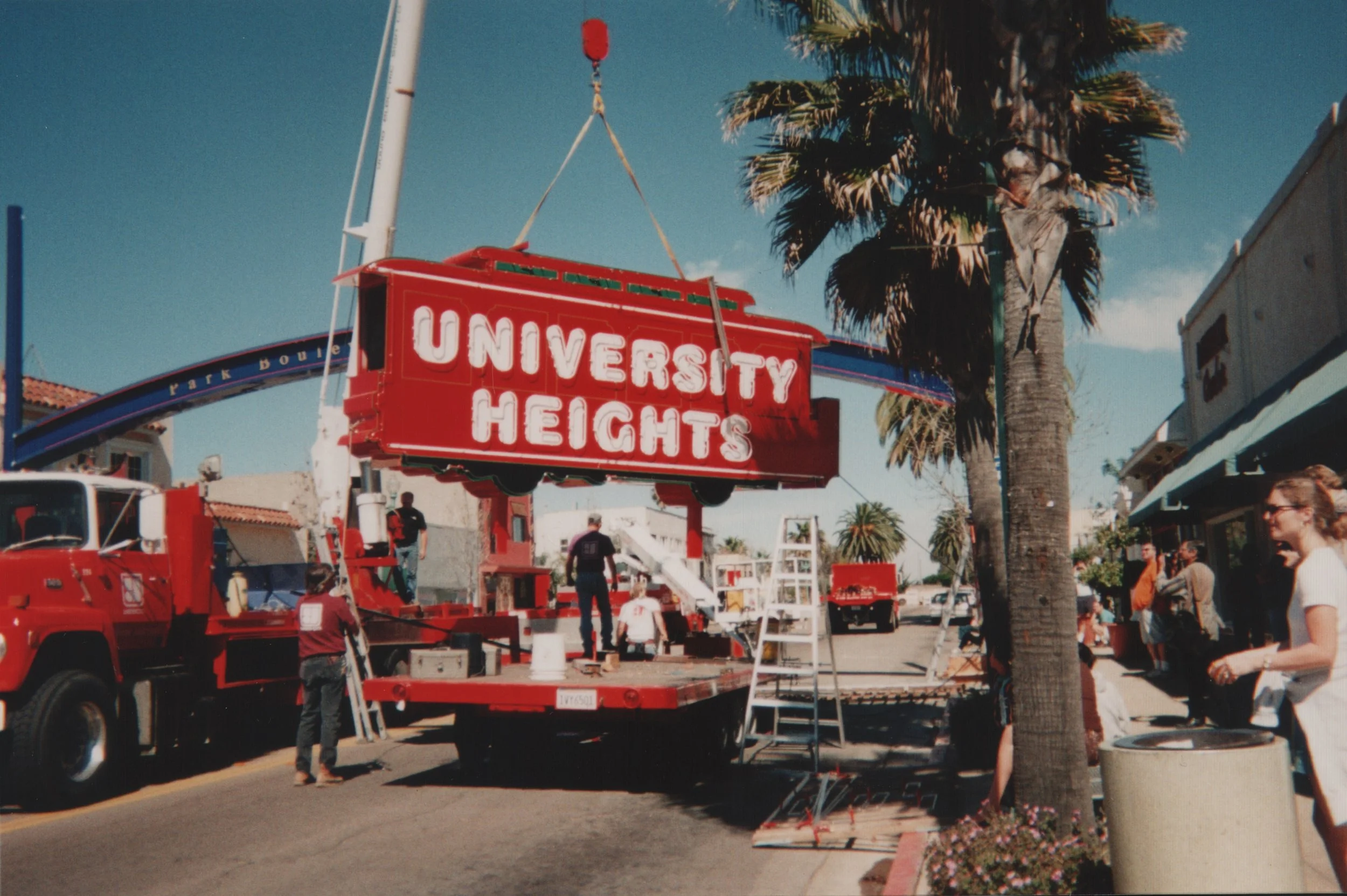
Learn about our beloved sign’s origins & history here:
For almost 30 years, the neon trolley arching over Park Boulevard at Madison Avenue has been the face of University Heights — the first thing visitors see and the image we put on everything from banners to T-shirts. The City of San Diego has alerted the community that for the first time since it was unveiled in 1997, it will be switched off, citing safety.
Part of the reason is age. The white neon spelling out "University Heights" has gone dark in patches on both faces, transformers are failing, some of the red tubing has burned out, and the paint is peeling and metal is rusting. That much is the simple truth of a 29-year-old sign subjected to our San Diego weather of bright sun and frequent foggy nights and mornings. The harder truth is the one that should make us angry: there is almost no money left to fix it, and that did not happen by accident.
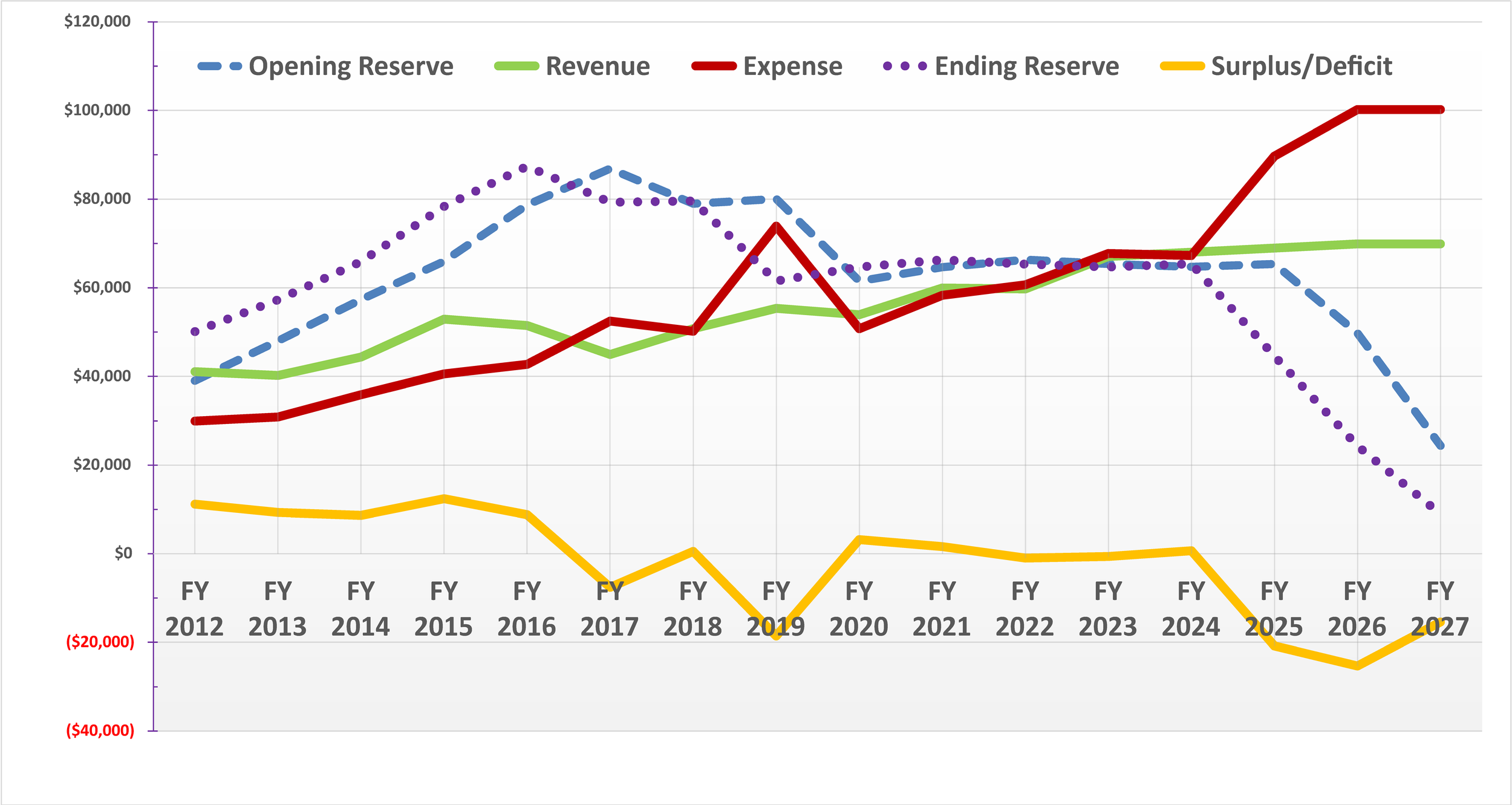
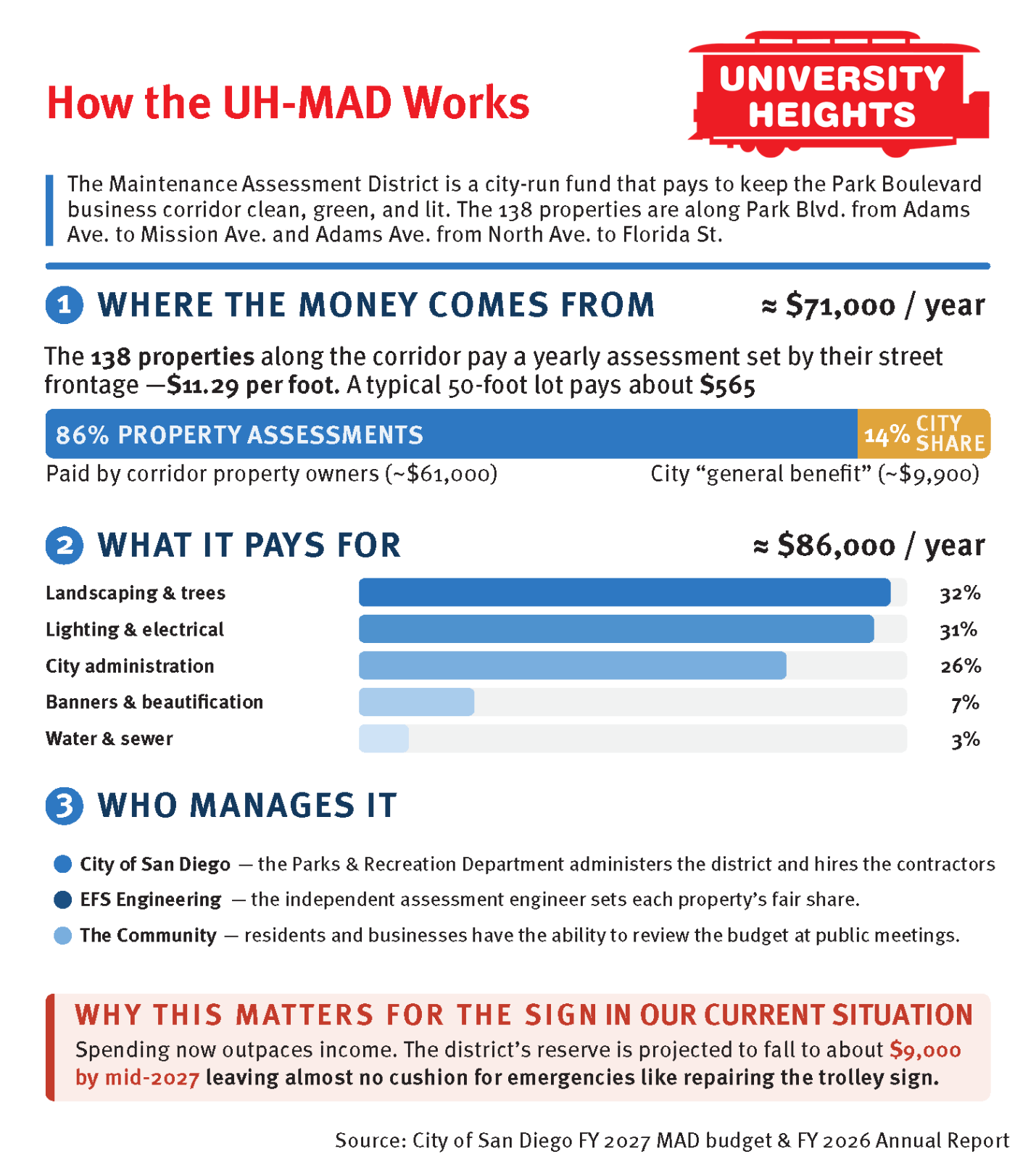
Chart created from officially filed UH MAD fiscal-year budget numbers: link.uhsd.org/madbudget
A Vanishing Reserve
Our sign is owned by the City and its maintenance — along with other benefits — are paid for by the University Heights Maintenance Assessment District (MAD) managed by the City Parks and Recreation Department. The MAD is funded by additional property taxes assessed on property owners within a defined "special benefits district." It is managed not by UHCA or UH Community Development Corporation (UHCDC), but by the City's Parks and Recreation Department (see sidebar on Page 4 for more details).
As recently as 2024, that fund held a healthy reserve of more than $65,000 — a genuine rainy-day cushion. It has been drained ever since. By the close of fiscal year 2025 the reserve had fallen to roughly $44,600. It is projected to drop to about $24,360 by the end of 2026, and to bottom out at a mere $8,962 by the end of 2027. Year after year, the City has spent more than the district takes in, and the savings that should have protected our landmark are nearly gone.
Where Did the Money Go?
It's a fair question, and we are still demanding line-by-line answers. What we can already see raises eyebrows. The City budgets around $30,000 a year for landscaping along Park Boulevard, yet weeds and neglected stretches are easy to find. Roughly $27,000 a year goes to utilities and electricity — including decorative lamppost lights that in many cases run 24 hours a day, literally burning through our budget in broad daylight. Funds have gone to extras like barely visible twinkle lights strung in the trees — strands the City's own tree-trimming contractor has since cut through and destroyed. All of this while the neighborhood's signature icon was left to fade. Whatever the full accounting shows, the cushion that should have covered our sign has been emptied by the very agency entrusted to manage it.
The Bill Comes Due
Having spent the reserves, the City has handed the problem back to the community to solve. We face two stark options, according to the sign's longtime vendor:
A roughly $25,000 "quick fix" replaces the failing white neon and transformers — buying us years of light — but leaves the faded paint, rusted metal and remaining aging red neon for later. A full $175,000 refurbishment would strip the sign, repaint it, and convert it to modern color-changing LED lighting. The quick fix is almost certainly the wiser first step: experts warn that today's outdoor LED can fail in as little as six to ten years, while quality neon still lasts roughly twenty.
Spend a little now, plan for when the technology — and our finances — are ready.
Either way, there's a catch. Because the district's reserves are nearly exhausted — and its ability to raise revenue is capped by law — the MAD can likely contribute only about $10,000. That leaves a significant gap just to keep the lights on.
Stepping Up — and Holding the City to Account
We are not waiting for permission. As your UHCA President and Vice President, we have both joined the MAD committee as active participants, working hand in hand with our partners at the UHCDC to chart a responsible path forward — pressing the vendor for firm numbers, exploring other options, hunting for grants, and putting pressure on the City — Councilmember Stephen Whitburn and Mayor Todd Gloria — to step up and put real dollars on the table. This entire funding gap was the City's making, and we need them to help fix it.
To address the gap in available funding and the immediate need to get the sign back up and running safely, this fall we will launch — in partnership with UHCDC — a community campaign, Save Our Sign, and we will need every neighbor and business with us, with both your voices and your wallets. But make no mistake: this is about more than a repair. It's about accountability. The City helped create this mess through fiscal irresponsibility, and we intend to hold them to account to help solve it.
Why This Is Important to UH
The University Heights trolley sign is far more than a mere physical structure; it is the most visible icon of our neighborhood and serves as a vital placemaker that defines our community's unique character. By paying homage to our history as an electric streetcar route — and crowning its pillars with the gold ostrich statues that nod to our old ostrich farm — the sign creates a distinct sense of place and a point of intense pride for residents. Beyond its aesthetic value, the sign acts as a powerful economic driver for the Park Boulevard business district. Positioned to mark our historic commercial core, identity signs like ours are recognized throughout San Diego as essential tools that promote neighborhoods as destinations, attract visitors, and signal a community's commitment to revitalization and economic development. To lose its light is to dim the very feature that anchors our identity and invites the world to discover what makes University Heights special.
Watch this space and our social media (@universityheights_sd) in the coming months. Our sign will shine again — and this time, let's make sure it stays lit.
Updates to Original Story
6/29: The power to the sign is completely off at 10:30pm (photo by Marc Johnson)
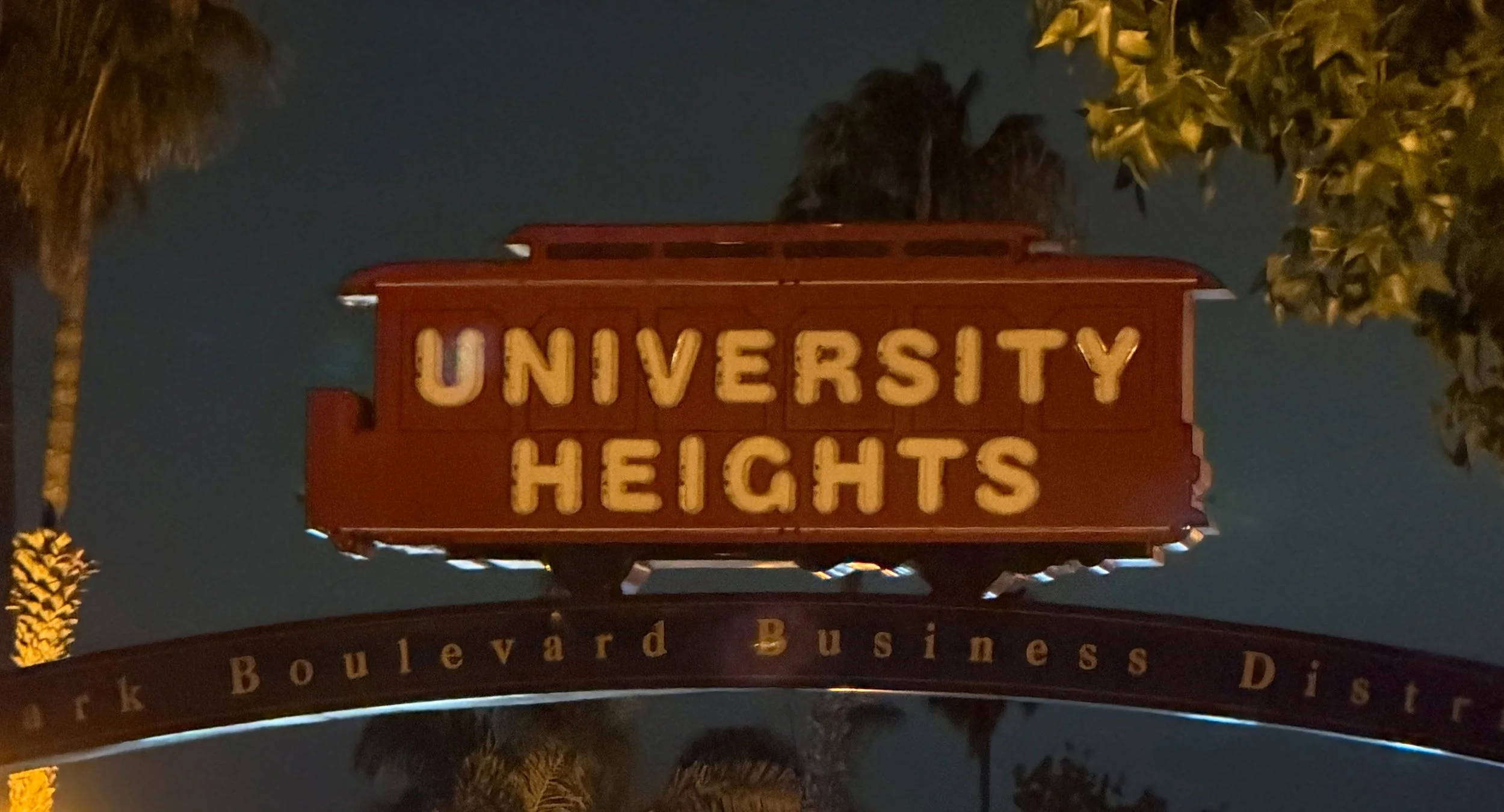
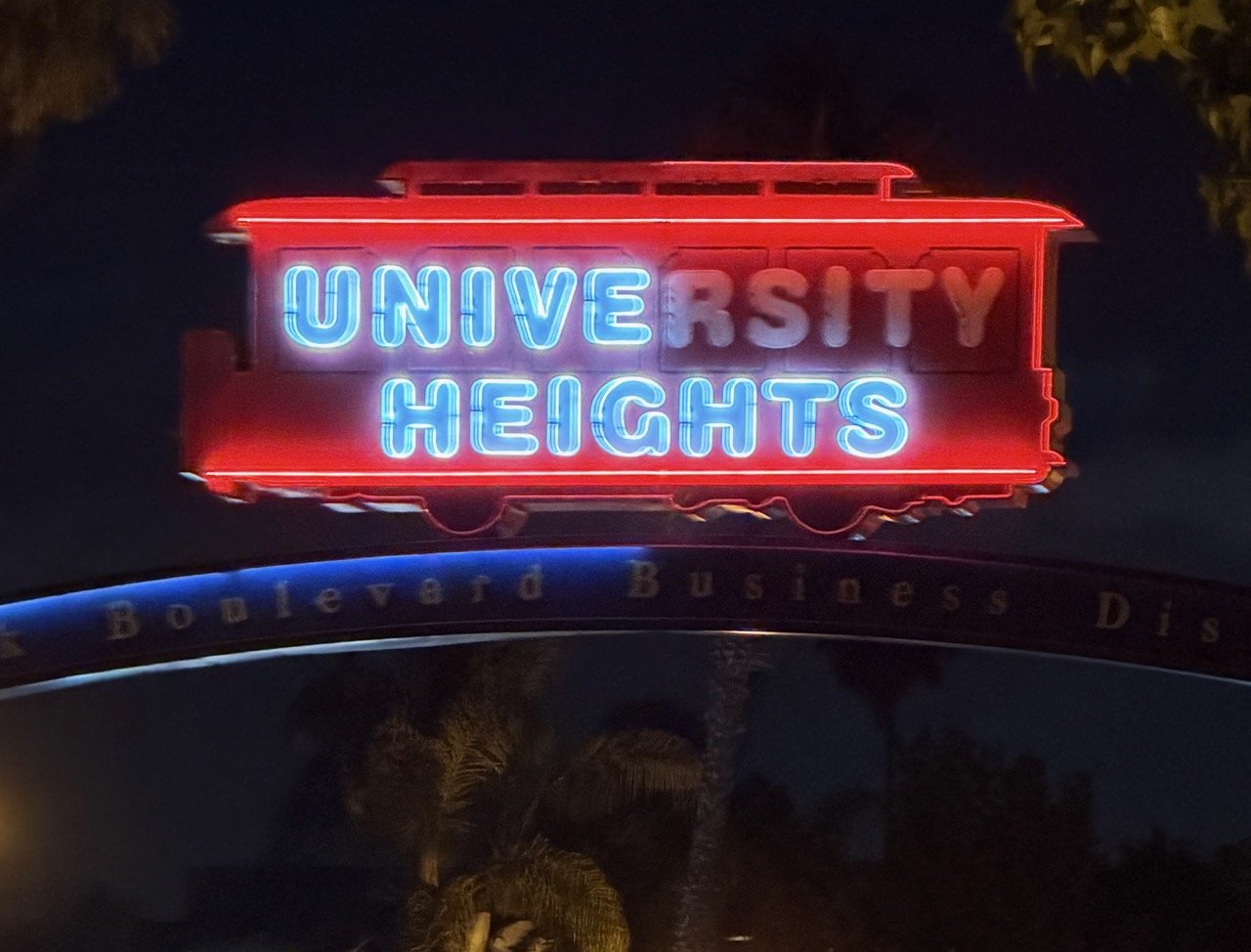
6/30: The power is back on but the major sections are still off (photo by Marc Johnson)
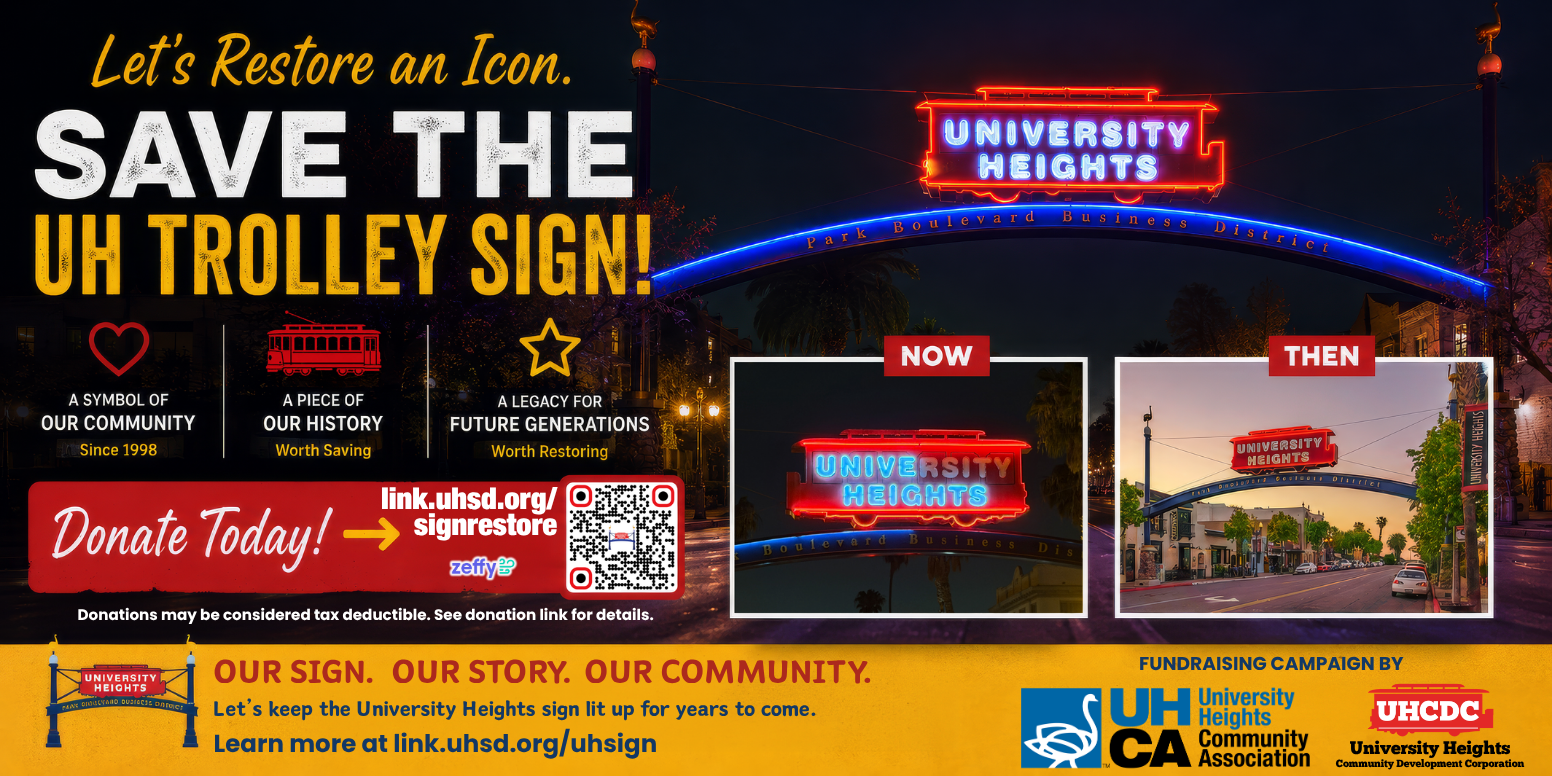
7/1: UHCA launches public fundraising campaign
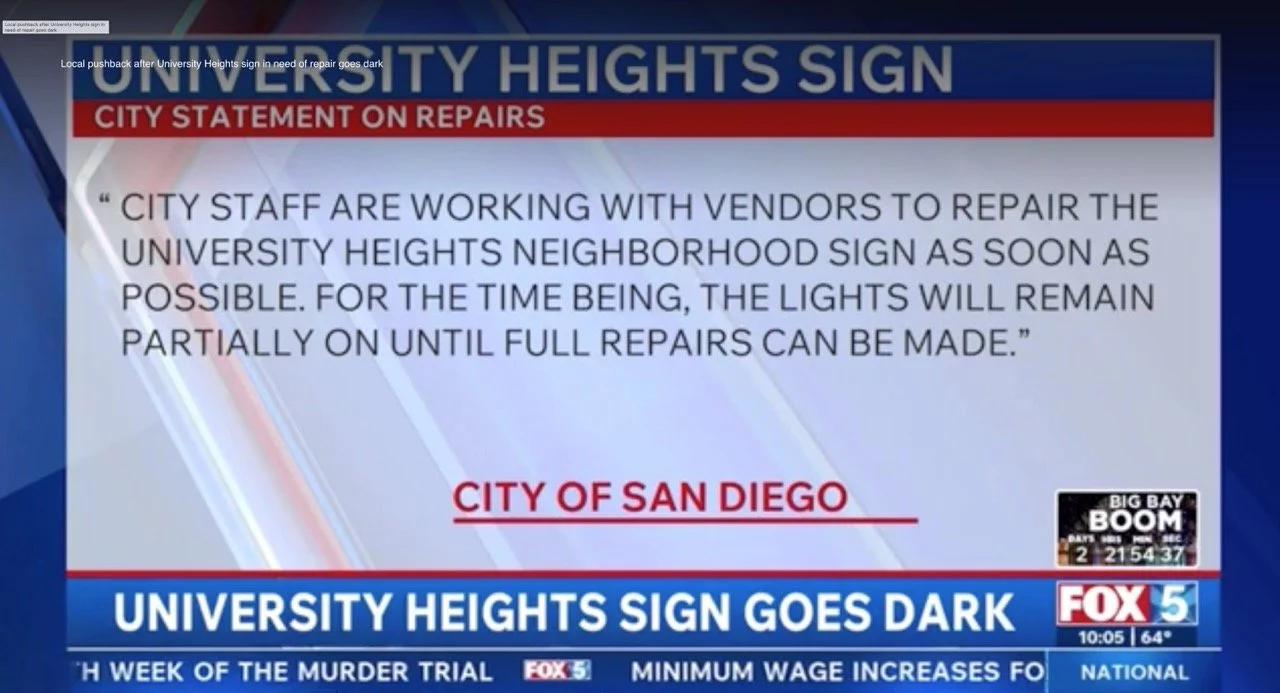
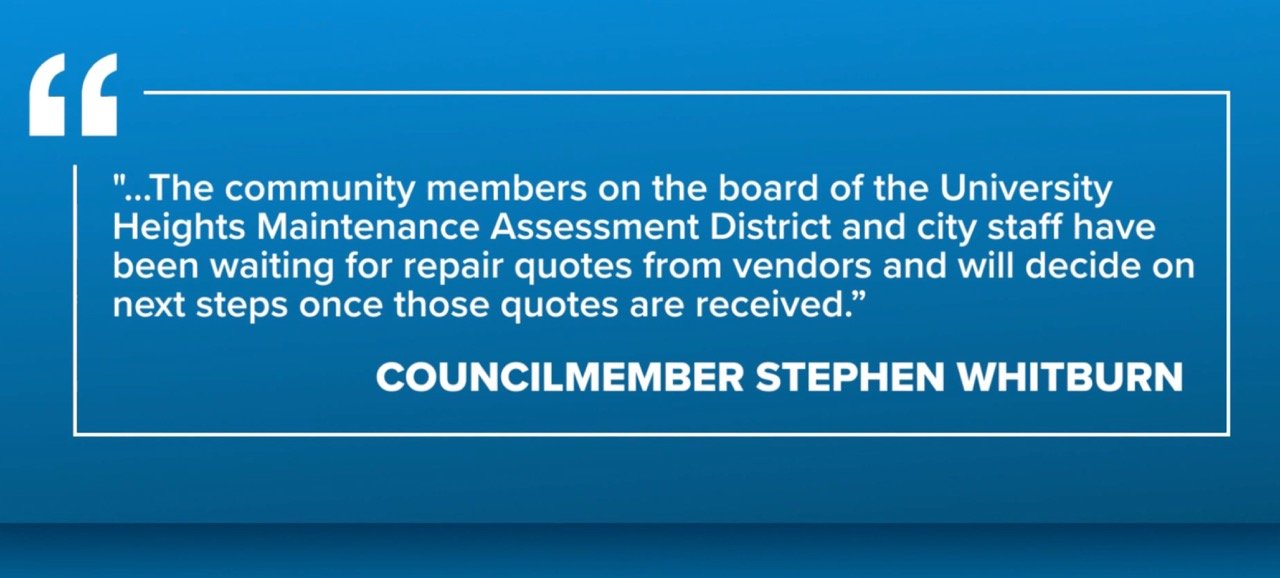
7/2: The City Responds. UHCA’s Marc Johnson spoke with the Director of MADs with the CIty Park & Rec department, and he expressed his frustration that things had gone off the rails. He committed to working collaboratively to get the sign repaired ASAP as well as to work with the community groups to restructure the MAD spending to better ensure it has the funds to properly maintain the sign. The City, through their spokepeople, has given the news media several public statements backing that up.
This is a great first step on the road to getting this fixed. But it’s not a solution. We will hold the City to their word, and at the same time work with them looking towards the future where we know that the sign is going to require a substantial renovation. That’s why we’re keeping the fundraiser going, to help build the financial cushion we know we will need to help with that effort. These funds will be safeguarded by UHCA in our credit union earning interest while the plans are put together between the City and our community groups.
7/2: Update from Marc Johnson:
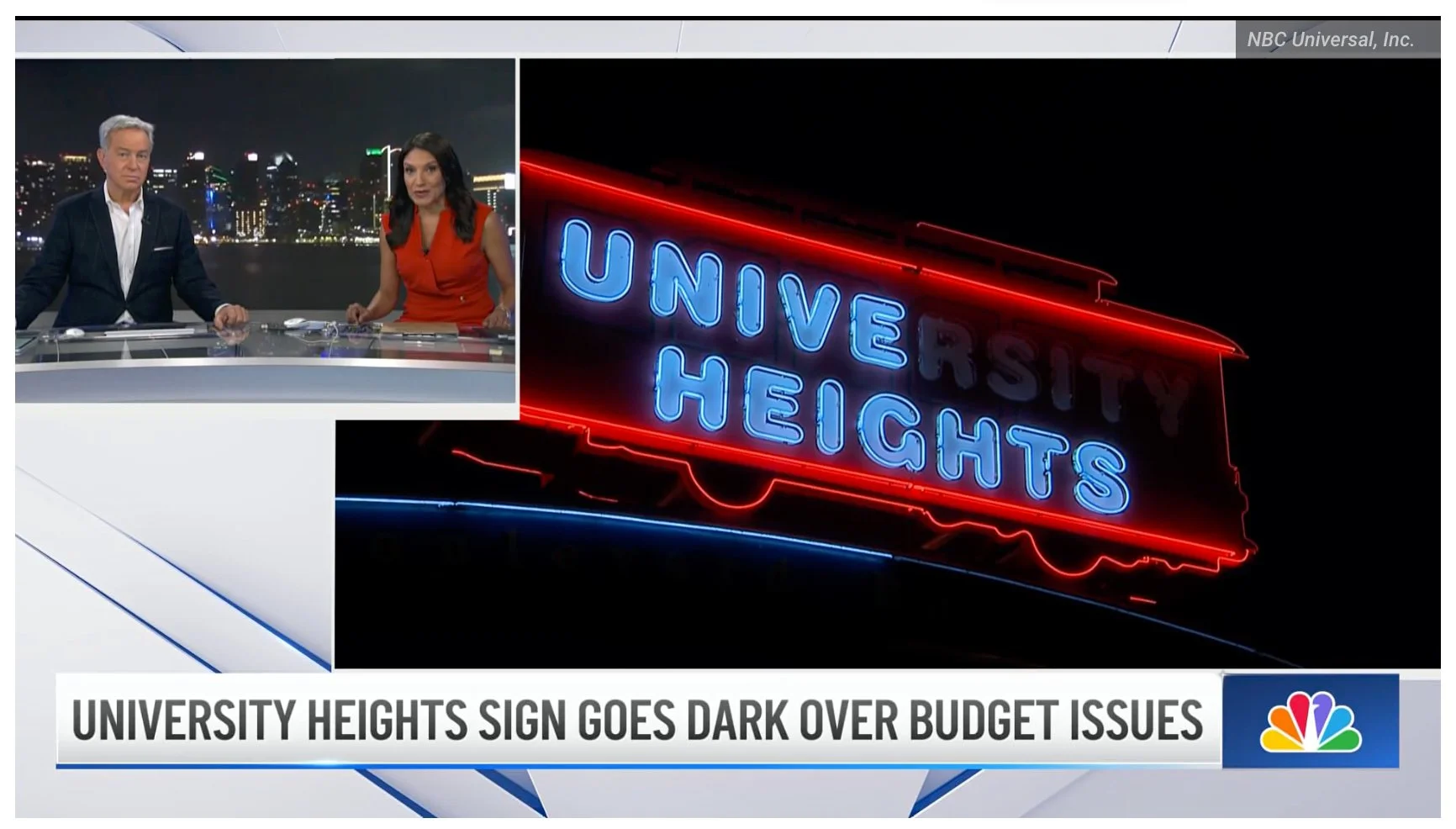
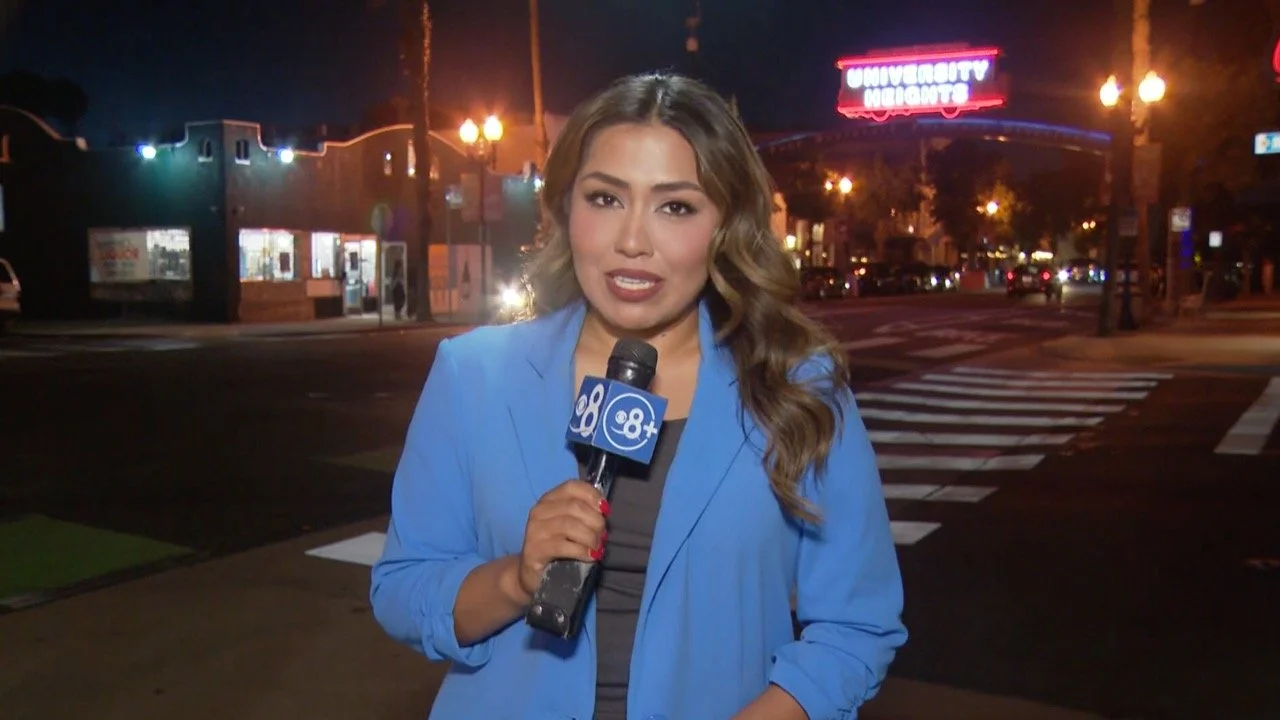
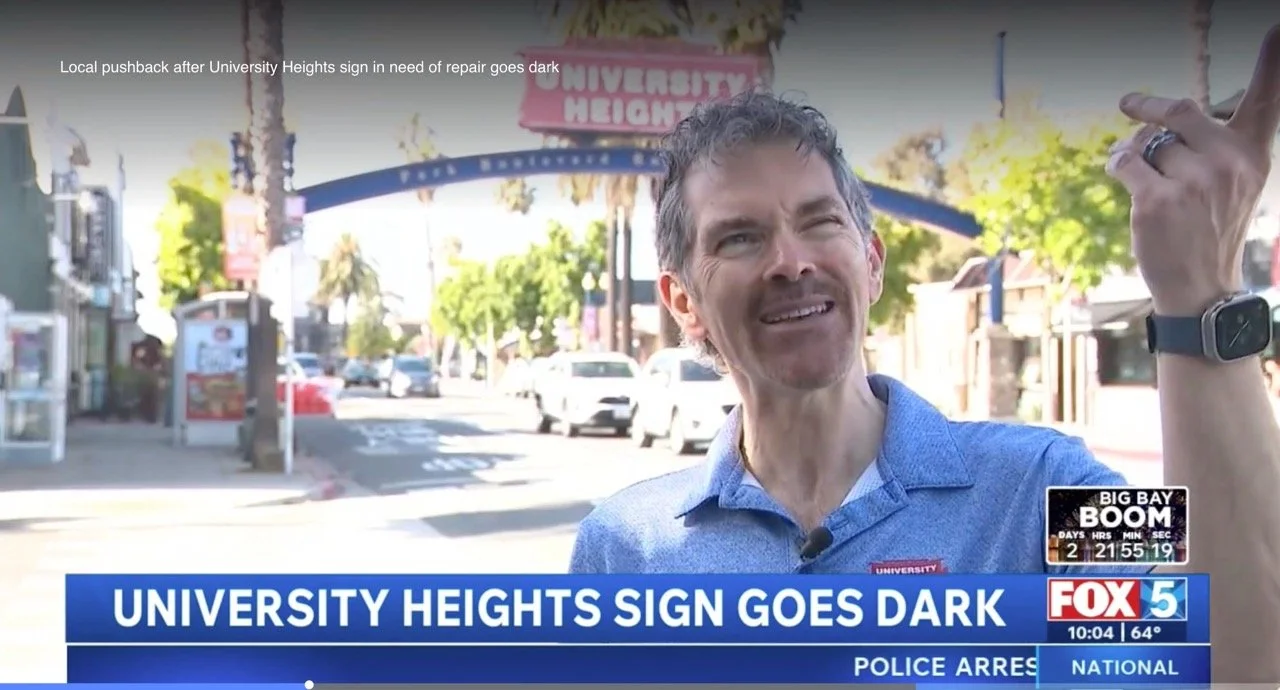
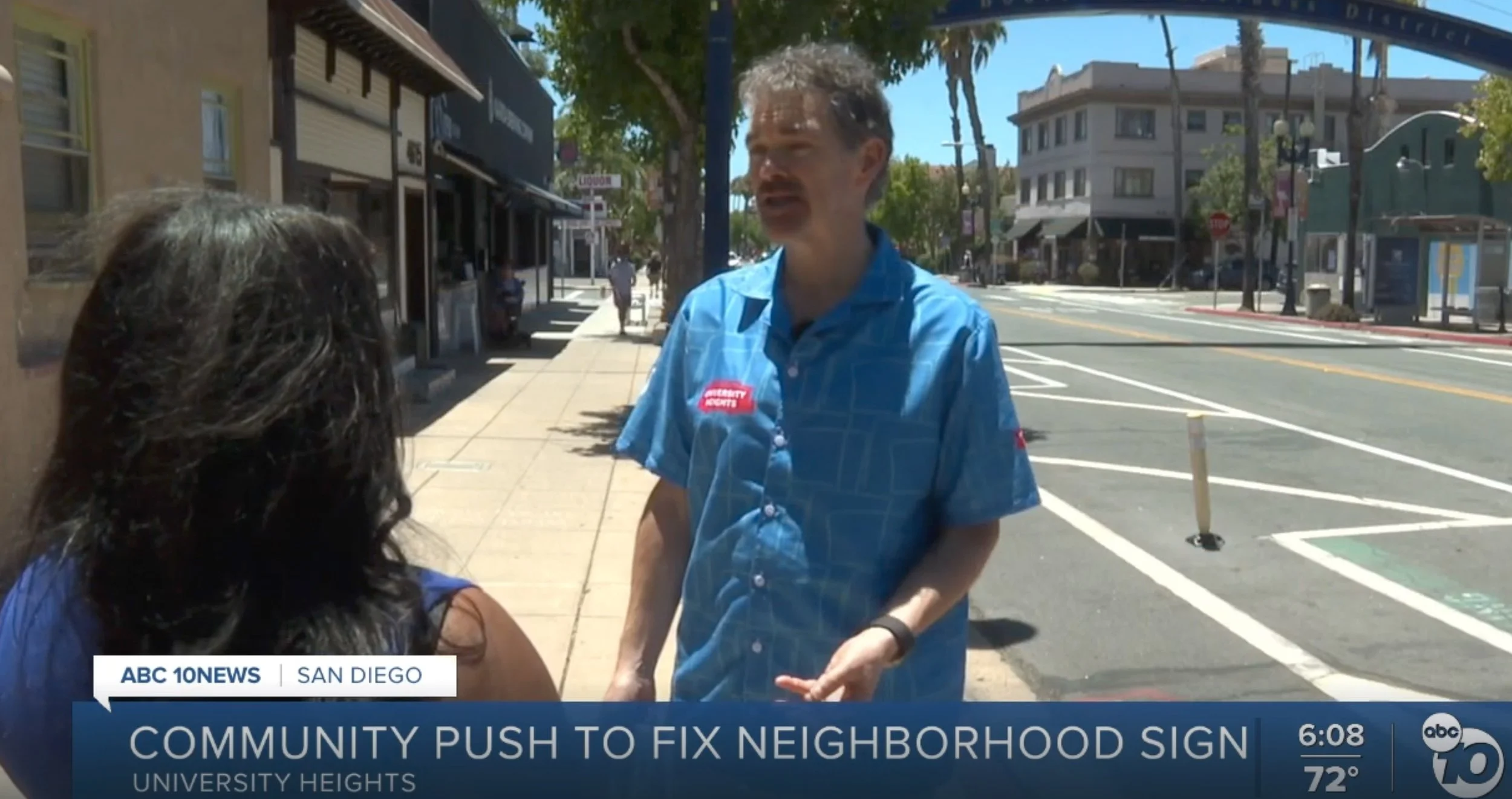
Yesterday was a very busy day. We had media inquiries from nearly every San Diego news organization and will post their stories here as we receive them. We posted this to social media:
It worked.
Thanks to an incredible community effort—and a strategic media push—the City has stepped up.
Today I spoke with the City’s Director overseeing the Maintenance Assessment Districts (MADs), and after being contacted by multiple news organizations, the City has now publicly stated that it will repair the University Heights Trolley Sign.
That’s fantastic news… and now let’s all help make sure it happens.
I’m especially proud that our volunteer-run, 5,800-circulation UH News helped ignite this conversation. It started with a neighborhood newspaper story, then spread across social media, television, and online news outlets. It’s proof that an active community association can make a real difference when neighbors work together.
The campaign isn’t over.
While we’re optimistic the sign will soon be shining brightly again, the long-term future of this neighborhood icon still requires significant investment. A complete restoration will likely cost well into six figures, and we’ll need to pursue grants, public funding, corporate sponsors, foundations, and community support to make that happen.
So we’re keeping the fundraiser going. Today’s commitment addresses the immediate repairs, but restoring this landmark for the next several decades will require a much larger investment. Our goal isn’t simply to fix the sign for today—it’s to preserve it for future generations.
Thank you to everyone who shared the story, donated, contacted the media, and kept this conversation alive. You made a difference.
I’d also like to thank our local news organizations for recognizing the importance of this issue and amplifying it so quickly. Their coverage reached thousands more people—and it only happened because this community created such incredible momentum online.
This sign has welcomed generations to University Heights. Together, we’ll make sure it welcomes generations more.