
By Lilly Irani
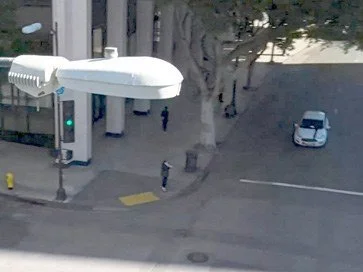
Image of streetlight camera courtesy of CBS8 News.
Editor’s note: This is the second of two perspectives on automated license plate readers in San Diego. The first article appeared in our October issue and can be accessed online at www.uhsd.org/blog/blog/what-alpr-is.
Behind the laundromat at Park and Madison, a deep blue wall with doves reminds us “Love thy neighbor.” As SDPD installs Automated License Plate Readers (ALPR) on our streets, loving thy neighbor means resisting this form of AI surveillance. For almost a year, more than 80 community organizations, including the San Diego and Imperial Counties Labor Council, have called on the City Council to “Get the Flock Out!”
On October 13, Councilmember Stephen Whitburn announced that he no longer supports Flock ALPR as they cause “too much fear for too many San Diegans.” These fears are founded.
A 2026 Washington Post investigation found 50 confirmed cases of officers charged with or accused of using these systems to stalk intimate partners. In Colorado, police accused the wrong woman of stealing packages based on Flock data; the accused spent a year gathering her own evidence to clear her name. At home, SDPD held Hugo Parra in jail for a month because his car surfaced in an ALPR search for a red Alfa Romeo, though he was five miles from the carjacking. He is now suing the City.
ALPR data is made for sharing. SDPD was caught sharing plate data with Border Patrol in 2018, and with 63 agencies including Homeland Security in 2024 in violation of San Diego and California law. It took activists and the state Attorney General to make it stop. Many do not feel safe even with in-state, legal data sharing. Neighboring El Cajon police work for a Mayor who has pledged to assist ICE.
Because data about San Diegans lives on third-party servers, courts can grab our data by subpoenaing or serving Flock warrants directly. Flock acknowledged at the June 27, 2025 City Council Public Safety Committee hearing that it receives such requests.
These automated license plate readers (ALPRs) do more than track where we go. These are not single-purpose tools but infrastructure, a foundation for new AI surveillance, prediction, and tracking with every software upgrade. Flock cameras can already search for people, bumper stickers, and other everyday objects in the field of view. Flock also creates heatmaps displaying everywhere you have been spotted in its network.
The line between resident and criminal is a political one. 404 Media discovered Texas police had used ALPR to search the US for a woman they believed had an abortion. Federal executive orders now name protestors, refugees, and even “anti-technology extremists” as security threats to be targeted with surveillance, arrest, or deportation. Closer to home, when the city’s police oversight commission found Black drivers 2.6 times as likely to be searched as white people, surveillance at a keystroke makes the already surveilled more vulnerable.
The law enforcement and security tech industry has boomed in recent years as venture capitalists seek to profit from the public purse. Real safety — public libraries, beachside bathrooms, community arts programs, and actual streetlights — doesn’t generate windfall tech profits. Once tech companies put their technologies on our streets, they will always seek to sell us the next upgrade: for Axon AI police reports as reported by Voice of San Diego, for Flock intelligence analysis databases as reported by Axios San Diego, just to name two examples. UC San Diego professor Kelly Gates finds that police tech companies like Flock and Axon profit from upgrading officer tech, not preventing crime.
Surveillance does not create safety. Police used ALPR to chase the shooters who killed three Muslim community members at the Islamic Center SD last May. Police arrived too late; it was ICSD security guard Amin Abdullah who lost his life delaying and distracting the shooters.
Surveillance makes many of us less safe and is a distraction from community safety we have to design together. Loving thy neighbor means not collecting data that puts them in harm’s way.
Lilly Irani is a Professor at UC San Diego who researches the relationship between technology and society. She lives near GoodOmen Coffee Co. We welcome submissions from readers, visit www.uhsd.org/submissions.