
What ALPR Is, and How SDPD Uses It
Editor’s note: This is the first of two perspectives on automated license plate readers in San Diego. A second article, taking a more critical view of the technology, will appear in the November issue.
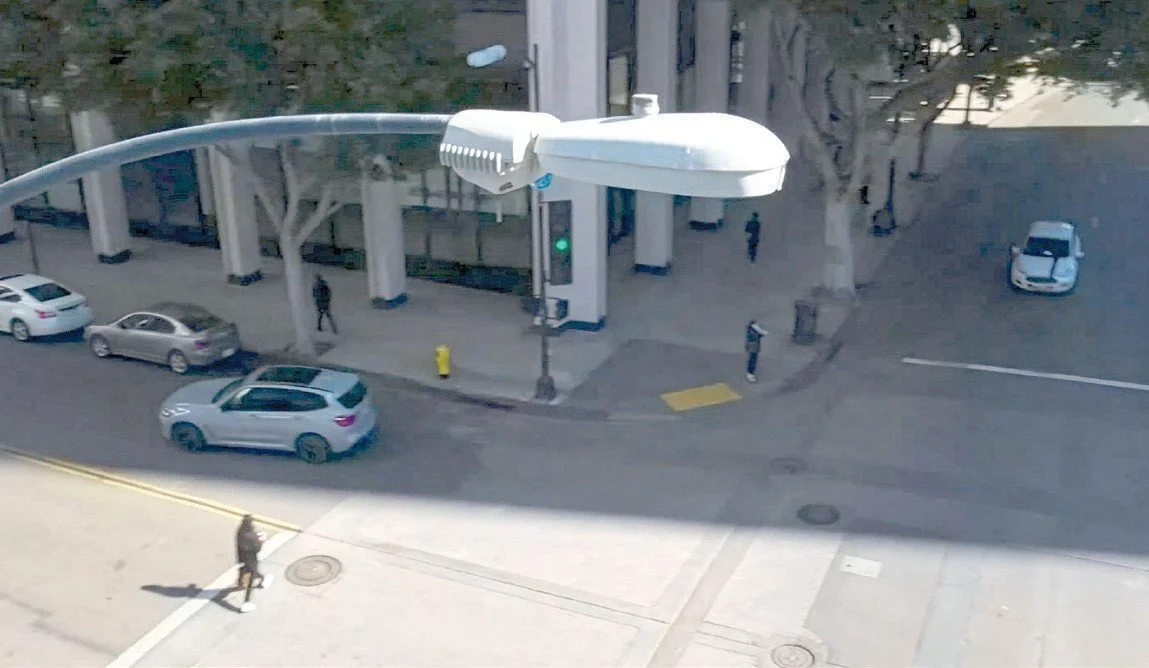
Image of streetlight camera courtesy of CBS8 News.
Automated license plate readers (ALPRs) are camera systems that photograph the rear of passing vehicles on public roadways. Several ALPR systems are on the market, including one made by Flock. The system records the license plate number, date, time, and location of the scan, along with basic vehicle details such as make and model. The system does not capture or record vehicle occupants. In San Diego, ALPR camera locations are published on the City’s website (link.uhsd.org/sdpd-technology) which also contains much more about how SDPD uses technology.
The San Diego Police Department uses ALPR technology for official investigative and public safety purposes. These include locating vehicles connected to criminal investigations, responding to critical incidents, and helping find at-risk missing persons. According to figures from the San Diego Police Department and Mayor Todd Gloria’s office, since December 2023, ALPRs have supported more than 600 investigations, helped recover over $5.8 million in stolen property and more than 440 stolen vehicles, and assisted in recovering at least 20 firearms. SDPD also reports that ALPR data contributed to solving about a third of the city’s 35 homicides in 2024.
SDPD’s use of ALPRs is governed by a detailed surveillance use policy (revised in 2025) with privacy and accountability safeguards. Under that policy, ALPR data is deleted after 30 days unless it is needed for a specific active criminal investigation. The current policy also bars direct access by outside agencies and prohibits sharing ALPR data with federal or out-of-state agencies.
The policy also bans use of ALPRs for immigration enforcement, personal purposes, discriminatory targeting, general surveillance, or any action that violates constitutional or legal protections. Officers must enter a case or incident number and select a crime type before searching the system, and searches entered for immigration-related purposes are automatically canceled. Supervisors conduct weekly audits, and the department says any misuse is investigated. SDPD describes these safeguards as supporting public safety while protecting civil rights and privacy.
A few examples of solved cases with the use of ALPRs:
A suspect in two armed robberies, in December 2023 and August 2024, was identified because they used the same vehicle in both crimes. They were sentenced to eight years in prison.
In March 2025, a bicyclist was struck and killed by two vehicles. ALPR data helped locate both vehicles, and the drivers were arrested for felony hit-and-run.
In Mission Valley, a man attempted to kidnap two children just days apart. Hours after the second attempt, an ALPR alert led officers to the vehicle, resulting in a traffic stop and an arrest.
In May 2025, detectives used the ALPR system to help locate a suspect who was arrested on nine counts of lewd and lascivious acts with a child in San Diego.
For more information about ALPRs from the San Diego Police Foundation, visit sdpolicefoundation.org/speak-up/.
The author sits on the SDPD Western Division’s Captain’s Advisory Roundtable as a representative of UHCA and this piece was provided to the SDPD Communications team to check for accuracy.