
From Orchid to Eyesore
What’s happening on the Vermont St. Bridge, and what to do about it
By Andy Lange & Deborah Morrison
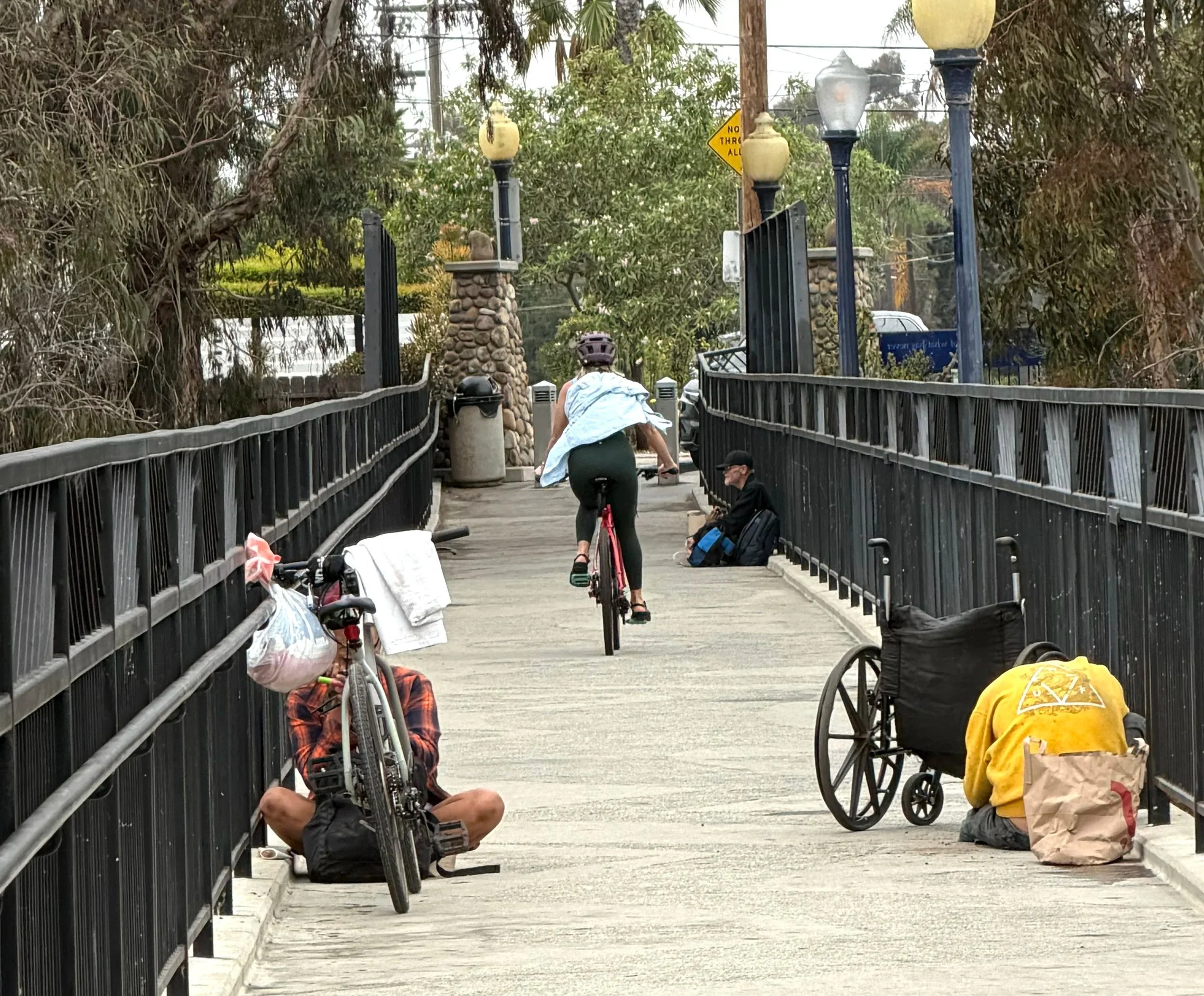
Open drug use, trash, urine, and vomit have all been reported at the Vermont St. Bridge. Photo taken on August 5, 10 a.m. 5 by Marc Johnson
Neighbors out for a morning walk. Graffiti. A dog on the way to doggie day care. Someone passed out on the walkway. A quick run to Trader Joe’s. Crime. A weekly group of bike riders. Feces.
Since opening to the public on Dec. 10, 1994, the Vermont Street Bridge has been a microcosm of life in University Heights. Lately, too much of that microcosm is the part no one wants.
Neighbors who live near the bridge, and those who cross it every day, have watched the number of people camping on and around it grow — and, in some cases, the crime along with it. Police have been called repeatedly over the past several weeks, and neighbors have filed a steady stream of Get It Done reports that have produced several arrests. Nobody at the City has explained why the increase is happening now, though many neighbors point to budget cuts to homeless services that pushed people out of downtown and into Hillcrest and University Heights.
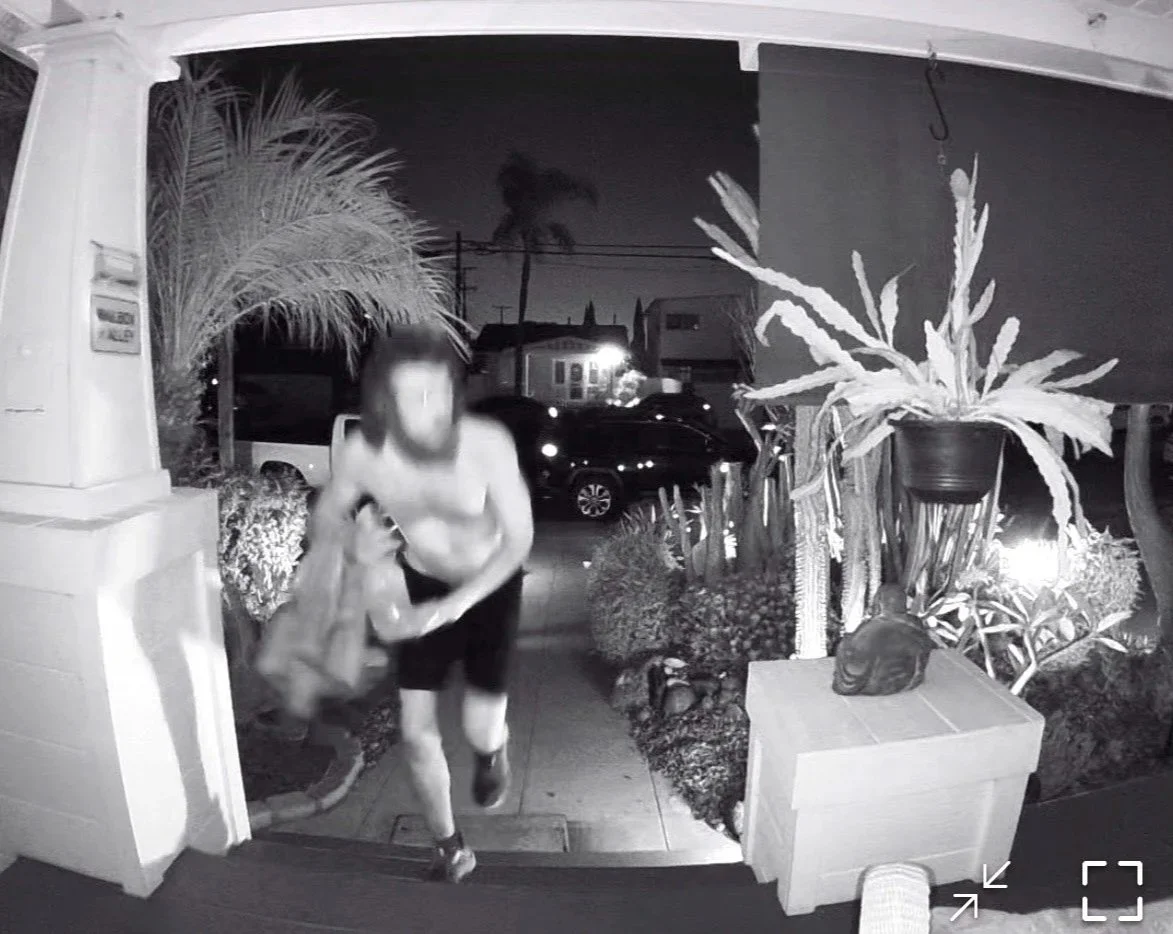
Ring camera photo from Deborah’s front door showing prowler who was apprehended after trespassing in a number of homes near the Vermont St. Bridge.
Late on a recent Monday night, a neighbor was awakened at about 10:50 p.m. when her motion lights came on. She heard someone in her yard and called 911. San Diego police responded in less than five minutes, as did a police helicopter with infrared tracking. Deborah Morrison, who lives nearby, received a call at 11 p.m. and heard officers quietly apprehending and arresting the intruder. Her Ring camera later showed the man — tall, slender, white, in his 30s, wearing only shorts and carrying his T-shirt — at her front door, mumbling and searching the porch before slipping into the alley, where he was arrested.
He appeared to be under the influence and made no attempt to enter the house or take anything, but the encounter was frightening nonetheless.
On the bridge itself, neighbors report a growing number of people sitting on the walkway, often blocking passage or making it difficult to cross. Some are using drugs or are sleeping, while others are passed out, and the bridge is regularly used as a toilet. That is both a health hazard and a public safety issue. Some neighbors no longer feel comfortable crossing after dark, or even alone during the day.
Our “Trash Talkers” — Andy (co-author of this article), Dawn, Benson, and John — clean on and around the bridge every Monday, and they have watched both the trash and the number of bridge occupants increase. Several months ago, near the State Route 163 on-ramp at Washington Street, two volunteers had their cars keyed, causing thousands of dollars in damage, and the crew has been drawn into repeated verbal confrontations. Both keyings were reported to police. Neither resulted in a citation. These are unpaid neighbors giving up their Monday mornings to clean a public bridge, and some of them are now reluctant to do it.
Despite the University Heights Community Association (UHCA) Beautification Team’s weekly routine of removing leaves and debris and emptying the trash can, the bridge has once again become an eyesore and an embarrassment — something to avoid rather than use as intended.
Whack-a-mole is not a strategy
None of this is a failure of the San Diego Police Department. Officers come out when they are called, subject to the priority of everything else in the queue that night, and they have been responsive and professional every time. The department’s community relations officer and her chain of command, up through the Captain, are well aware of conditions here and of how diligent this community has been about documenting them. But by the time a unit arrives, the person is usually gone. And unless someone is actually breaking the law, there is little an officer can do beyond asking them to move along — something neighbors have done themselves, many times over.
That is the real problem. Enforcement on the bridge works the way canyon cleanouts by the City and Caltrans do: people scatter for a few hours or a few days, then go right back. It is whack-a-mole. Moving someone off the bridge does not give that person anywhere else to be, so the bridge is where they return. We can clean it every Monday and call it in every night, and the outcome will not change, because the outcome is not ours to change.
The question is political.
What are Mayor Todd Gloria and Councilmember Stephen Whitburn doing about the root problem — the shortage of shelter beds, treatment options, and services that leaves people with nowhere to go but our sidewalks, our canyons, and our bridge? Cuts to homeless services have consequences, and University Heights is living with them. Our appeals to the Councilmember’s office have been met with excuses rather than action. Neighbors deserve a plan and a timeline, not another round of whack-a-mole.
In 1995, our beloved bridge was awarded a prestigious “Orchid” by the local chapter of the American Institute of Architects. What would its members think of it now? And what can you do now?
Report, report, report
Reporting will not clear the bridge tonight, and it may not produce a citation — ask the two volunteers whose cars were keyed. What it does is build a record. A single call disappears; a documented pattern is what moves a location up the priority list, and it is what we can put in front of the Mayor and the Councilmember when we ask for something better than dispersal. So report everything, and use the right channel:
Life-threatening or violent situations, or a crime in progress: call 911. Dispatchers are trained to evaluate urgency and set response priority. Never attempt to address a situation on your own.
Non-emergencies — someone camping or loitering, erratic or alarming behavior, or a crime that has already happened: call the SDPD non-emergency line at 619-531-2000.
Everything else — trash, human waste, graffiti, encampments, needles: file a Get It Done report at sandiego.gov/get-it-done or through the app on your phone. You can also file a police report online at sandiego.gov under Public Safety > File a Police Report.
The greater the number of reports submitted on any one area or issue, the more attention it will get.
Be as specific as you can in every case, describing the person or people, the situation, and the exact location. If you can do so safely, include a photo. You can also search other reports and use photos neighbors have already posted for the same issue. And when officers do arrive, treat them well. Our standing with SDPD matters, because they are the ones who will be there when we really need them.
UHCA is planning a Bridge Clean-Up on Saturday Aug. 29 at 8 a.m. Please sign-up and join us, even if only for an hour, to help keep our bridge clean. Cleaning it ourselves isn’t a solution, but is a statement: this bridge belongs to our neighborhood, and we have not given up on it. Info & sign-up at link.uhsd.org/vtclean.
Let’s not let our iconic bridge fall into blight. Let’s show everyone that the Vermont Street Bridge’s Orchid is still in bloom and well deserved.
One more reminder: especially with summer heat, always keep your doors and windows locked — including your vehicles — and do not leave items of value in view.
Claude Opus 5, an AI tool, was used to combine two planned articles — one on bridge activities, one on neighborhood crime — into this single piece. The authors and UH News copy editors then made final edits.