
Foundations for the Future: Survey Results
Residents' Vision for University Heights

As University Heights continues to grow, a new data set provides a clear look at the values and priorities of our neighbors. The results of the 2026 Community Development Survey serve as a roadmap for the neighborhood's evolution and reveal a community open to growth, provided that the physical and historical foundation of the area is maintained. It also vividly captures the struggles inherent with growth and change.
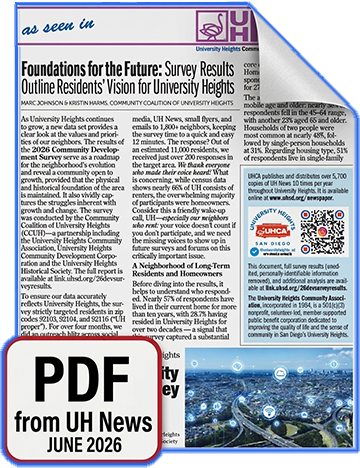
The survey was conducted by the Community Coalition of University Heights (CCUH)—a partnership including the University Heights Community Association, University Heights Community Development Corporation and the University Heights Historical Society. The full report is available at the link below.
To ensure our data accurately reflects University Heights, the survey strictly targeted residents in zip codes 92103, 92104, and 92116 ("UH proper"). For over four months, we did an outreach blitz across social media, UH News, small flyers, and emails to 1,800+ neighbors, keeping the survey time to a quick and easy 12 minutes. The response? Out of an estimated 11,000 residents, we received just over 200 responses in the target area. We thank everyone who made their voice heard!
What is concerning: while census data shows nearly 66% of UH consists of renters, the overwhelming majority of participants were homeowners. Consider this a friendly wake-up call, UH—especially our neighbors who rent: your voice doesn't count if you don't participate, and we need the missing voices to show up in future surveys and forums on this critically important issue.
A Neighborhood of Long-Term Residents and Homeowners
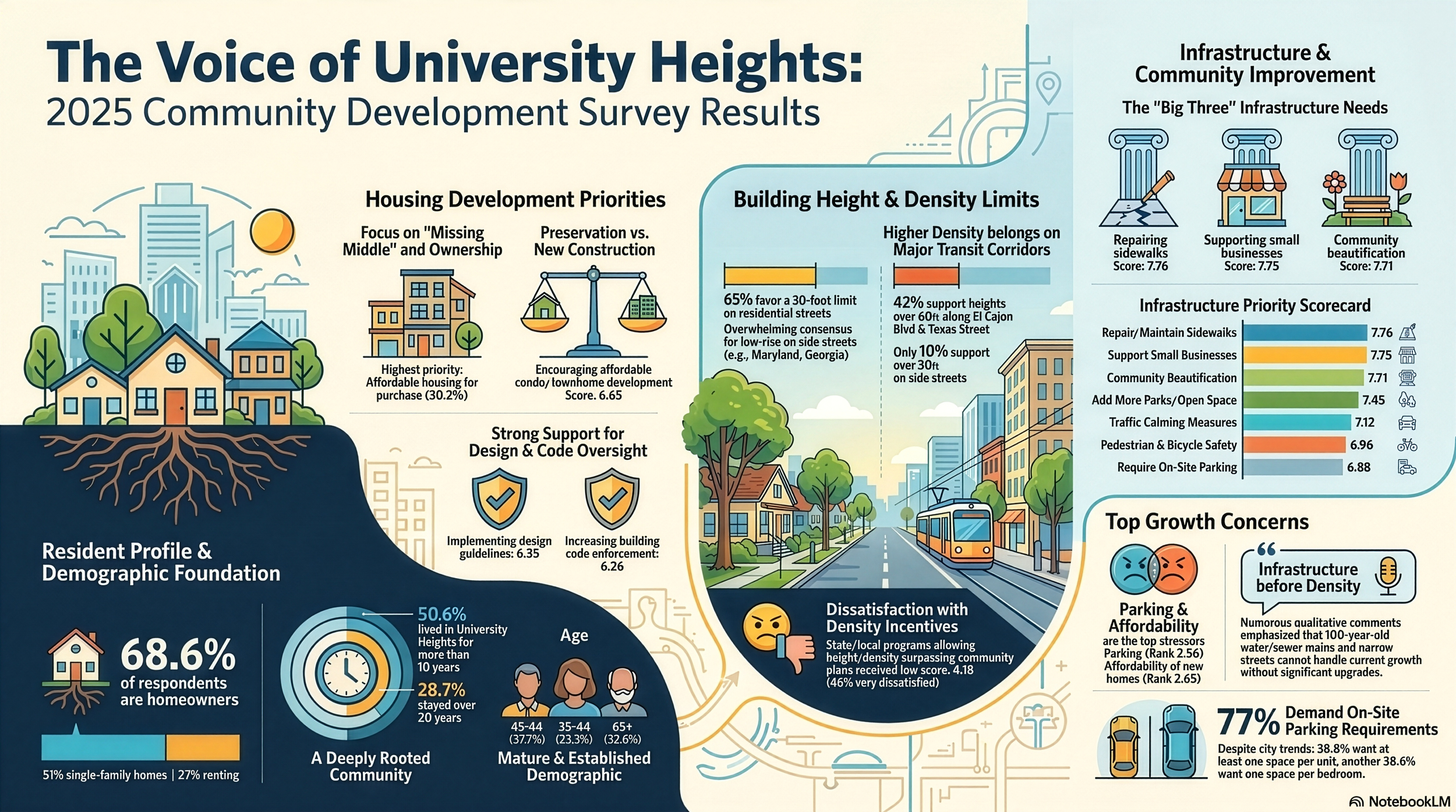
Before diving into the results, it helps to understand who responded. Nearly 57% of respondents have lived in their current home for more than ten years, with 28.7% having resided in University Heights for over two decades—a signal that this survey captured a substantial core of long-committed neighbors. Homeowners made up 68.6% of respondents, with renters accounting for 27%.
The age profile skews toward middle age and older: nearly 38% of respondents fell in the 45–64 range, with another 23% aged 65 and older. Households of two people were most common at nearly 48%, followed by single-person households at 31%. Regarding housing type, 51% of respondents live in single-family homes while 47% reported living in multi-family units including apartments, bungalow courts, condominium complexes, duplexes, and townhomes.
Top Concerns and Priorities
When asked to rank their top 3–5 concerns regarding growth and development in University Heights, respondents reported the following (a lower number indicates more importance):
Lack of parking (2.56)
Affordability of new homes (2.63)
Increased traffic (2.97)
Loss of historic homes (3.2)
Loss of Naturally Occurring Affordable Housing (3.63)
Respondent priorities regarding new development generally echoed their concerns. A higher score (from 1–9) indicates more importance:
Require sufficient onsite parking (7.07)
Encourage more affordable housing for purchase (6.65)
Preserve Naturally Occurring Affordable Housing (6.63)
Require sustainable building practices in new construction (6.59)
Increase the number of family size (2+ bedrooms) units (6.36)
Implement design guidelines for new construction (6.35)
Foundations First: Infrastructure Before Growth
The survey results suggest a "ground-up" approach to neighborhood planning. Before considering large-scale vertical developments, residents are calling for a renewed focus on essential infrastructure. Top ranked priorities for infrastructure improvement include the following (a higher score indicates more importance):
Repair and maintain sidewalks (7.76)
Support small businesses (7.75)
Community beautification including sidewalk cleaning, graffiti removal, landscaping (7.71)
Add more parks and open space (7.45)
Implement traffic calming measures such as stop signs, crosswalks, speed bumps, traffic circles (7.12)
"The infrastructure of our neighborhood such as streets, alleys, sidewalks, curbs, parking spaces, sewage and storm drainage is already lacking and already does not support the density that exists now. These fundamental issues need to be addressed BEFORE more homes are added to an already failing infrastructure."
Affordable Housing and the "Missing Middle"
Respondents expressed concern about the loss of Naturally Occurring Affordable Housing (NOAH) in University Heights and developer incentives for high density rental apartments.
Respondents expressed a strong desire to preserve Naturally Occurring Affordable Housing and to build larger family size, deed-restricted affordable units for purchase. "Deed-restricted Affordable Housing for Purchase" is the top priority at 30.21%, followed by market-rate housing for purchase at 28.50%. Market-rate rentals, by contrast, were the lowest priority at 16.32%.
To address the lack of affordable homes for purchase, respondents advocate for a "Missing Middle" housing strategy that prioritizes the construction of duplexes, triplexes, and condominiums in small multi-unit buildings for purchase (67.27%), and the provision of low-interest loans and grants for the renovation of older properties (NOAH) with stipulations for affordability (60.63%).
Residents also showed support for promoting tenant protections (52.44%) and alternative forms of homeownership, such as community land trusts (50.13%).
The 30-Foot Line: Protecting Neighborhood Scale
In addition to single-family homes, University Heights offers a wide variety of low scale but moderately dense housing types that includes duplexes, bungalow and cottage courts, and apartments. The 2025 data reflect a strong desire to protect this human-scaled architecture.
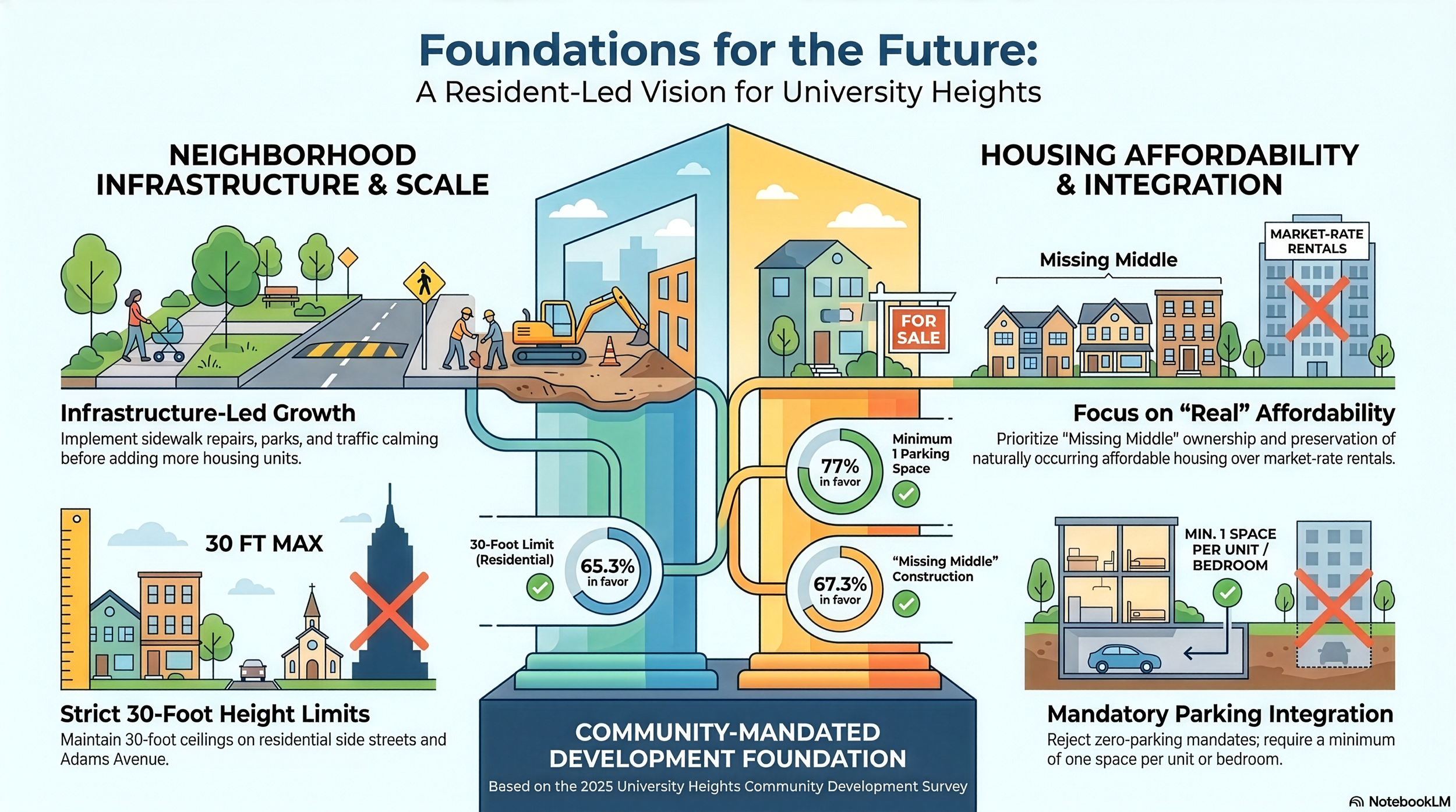
Residential Streets: 65.32% of respondents favor a 30-foot height limit on residential corridors like Maryland and Georgia Streets.
Transit Corridors: The picture is more nuanced for transit corridors. Along El Cajon Boulevard, Texas Street, and Park Boulevard south of El Cajon, about a third of respondents (33%) would allow up to 50 feet, while nearly 25% would permit 51–60 feet.
Adams Avenue: Support for increased height drops significantly on Adams Avenue, with 44.59% of respondents insisting on a 30-foot cap to preserve the area's historic feel.
"Preserve the 'Bungalow' Scale. The priority should be protecting the low-rise character of our side streets. High-density 'box' buildings do not belong in the middle of historic bungalow blocks."
The Parking Paradox: Spaces for People and Cars
Despite a citywide shift toward "transit-priority" planning, the lived reality for many San Diegans remains tied to vehicle ownership. The survey highlighted a significant tension between current policy and resident needs.
Parking remains a primary concern, ranking 2.56 on a scale of 1 to 7 (where 1 is most important). Furthermore, over 77% of respondents demanded that new construction include at least one parking space (which was evenly split with 38.5% per unit, and 38.5% per bedroom). This suggests that residents view current "zero parking" loopholes as a primary source of friction in the neighborhood, as one responder stated:
"The 'Transit Priority Area' loophole that allows zero parking is a disaster for our neighborhood. We should prioritize a 1-space-per-bedroom minimum for all new projects to save our residential street parking."
A Community in Conversation With Itself
What the open-ended comments reveal, perhaps more than any data point, is a neighborhood in genuine tension. Some residents are urgently calling for more density, more transit, and more housing of all kinds, arguing that restrictions price people out and deepen the regional housing crisis.
Others are sounding alarms about infrastructure capacity, neighborhood scale, parking, and the pace of change. Many are somewhere in between—supportive of thoughtful growth but skeptical of developer-driven solutions. That divide was captured honestly by one renter who wrote:
"I want desperately to stay in this neighborhood that I love and regularly give back to as a volunteer. I dread the day that I will be priced out—because where will I go?"
And by a longtime owner who offered a different kind of plea:
"Let the neighborhood keep its humanity and flavor. We need to figure out how to make the housing that exists more affordable for people, rather than catering to landlords and only figuring out how to maximize profits."
A Strategic Roadmap for Policy
The 2025 Community Development Survey serves as a vital tool for future advocacy and planning. By emphasizing infrastructure, historical scale, and affordability, the residents of University Heights have provided a clear vision for growth that is truly affordable, sustainable, and respectful of the neighborhood's 138-year history.
The report concludes with an "Action Matrix" of community-mandated requirements which our organizations can use to inform advocacy with our partners, planning groups, and the City of San Diego to shape future planning priorities:
Infrastructure-Led Growth: Implement infrastructure improvements before adding more units including sidewalk repair, more parks and open space, traffic calming measures, and planting more shade trees.
Parking Integration: Reject zero-parking mandates in favor of a minimum one-space-per-unit or bedroom requirement.
Focus on Real Affordability: Shift incentives away from market-rate rentals toward a "Missing Middle" strategy that includes preservation of Naturally Occurring Affordable Housing (NOAH), and construction of larger family size, deed-restricted affordable units for purchase.
Height Restrictions: Impose strict 30-foot ceilings on residential side streets and Adams Avenue.
Authors' note: we utilized Google's NotebookLM AI tool to assist with the analysis of the raw survey data. While the AI tool created the first draft of this summary article and the infographics, it was then checked for accuracy against the survey data, edited and expanded on by Marc Johnson and Kristin Harms. The complete survey report is available at the link below.
Background & Additional Information
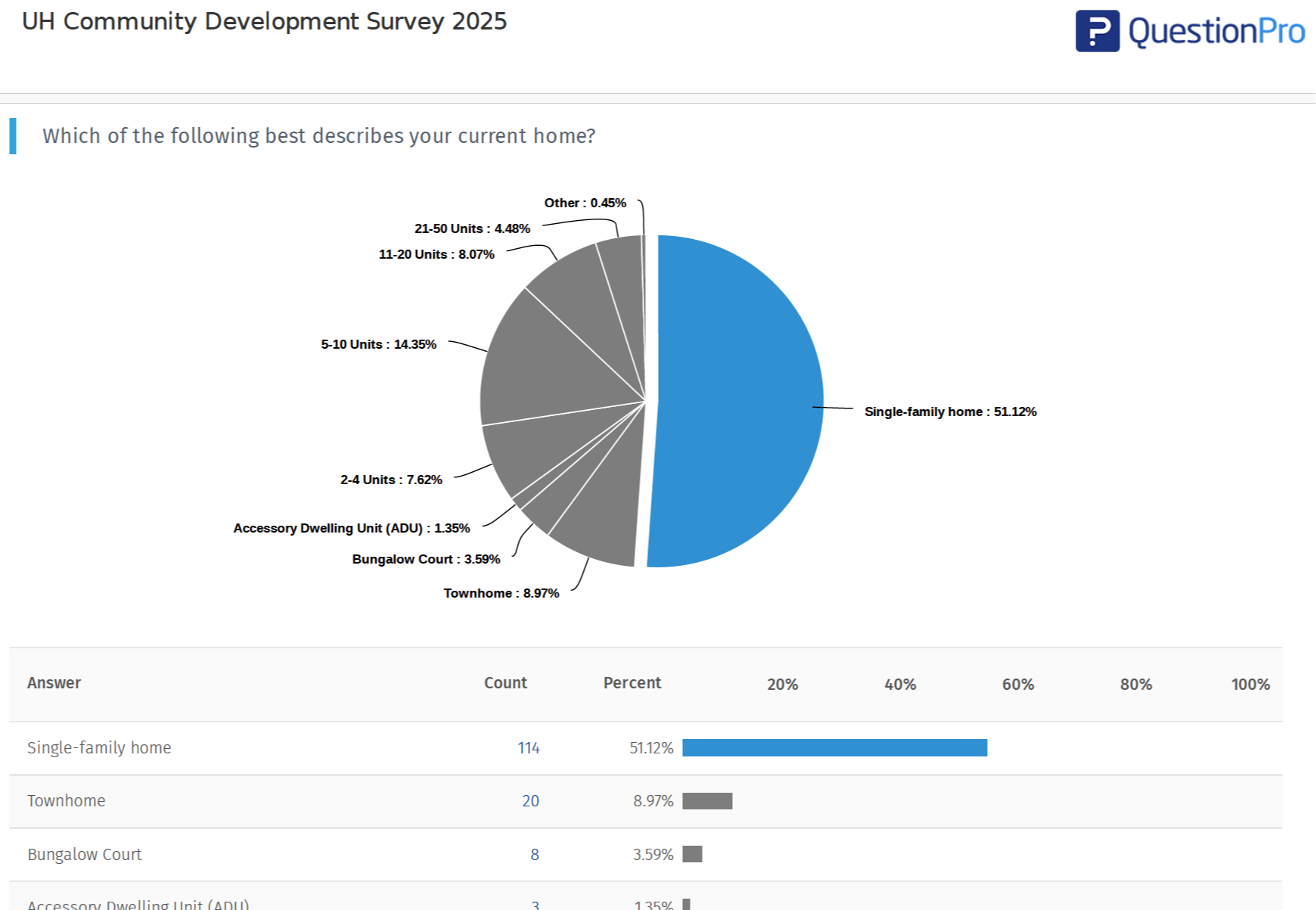
This is the “raw” report produced from SurveyPro, the software used to conduct the survey. This includes every comment unedited, with any personally identifiable information (IP addresses and emails) removed.
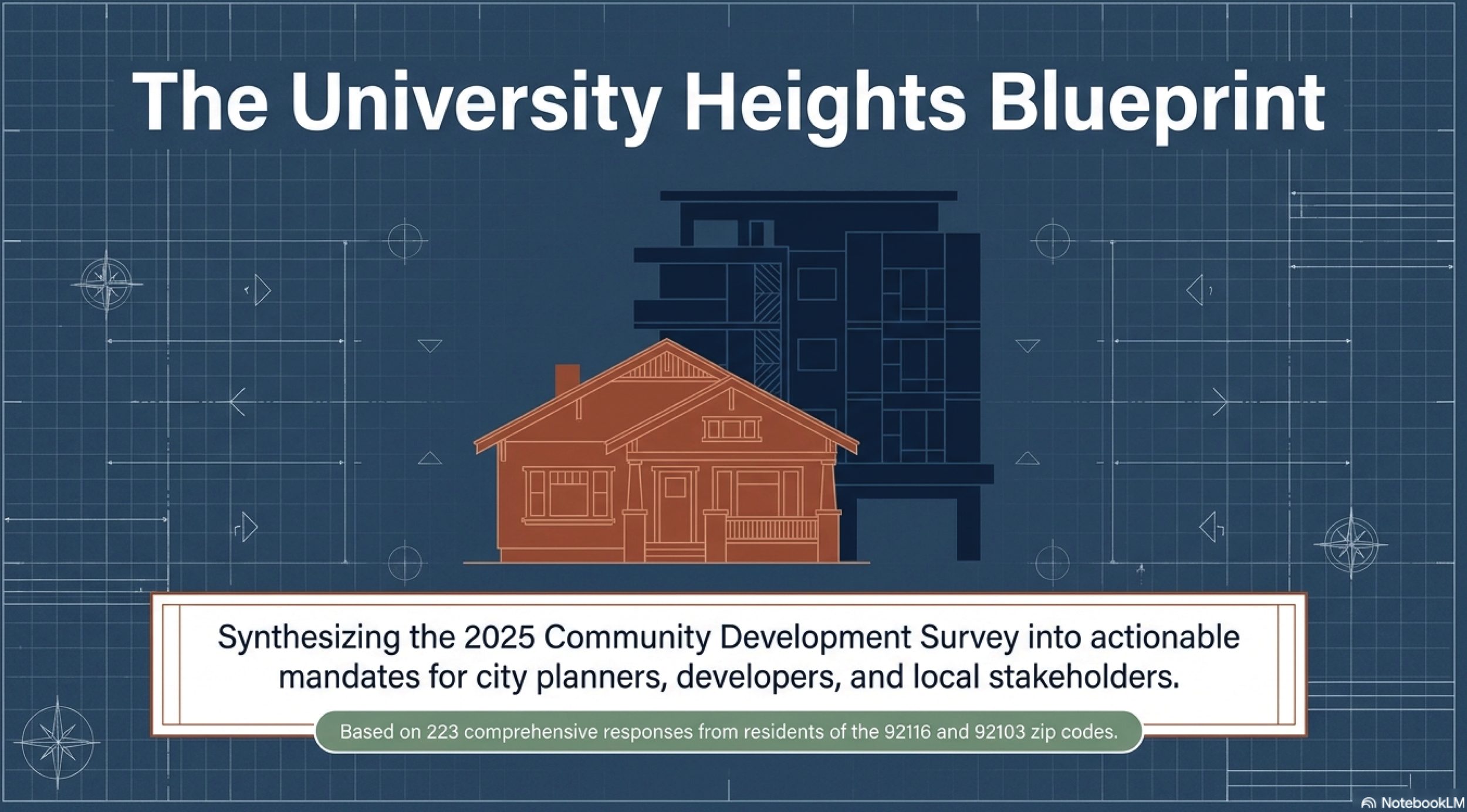
This presentation was generated by Google NorebookLM from the original survey data from QuestionPro. The data in this document has been reviewed by humans for accuracy and the conclusions are an accurate assessment of the survey data, however the recommendations are considered advisory and do not represent official positions of CCUH or any of it’s component organizations.
A reference guide generated by NotebookLM on how to interpret the survey results.